
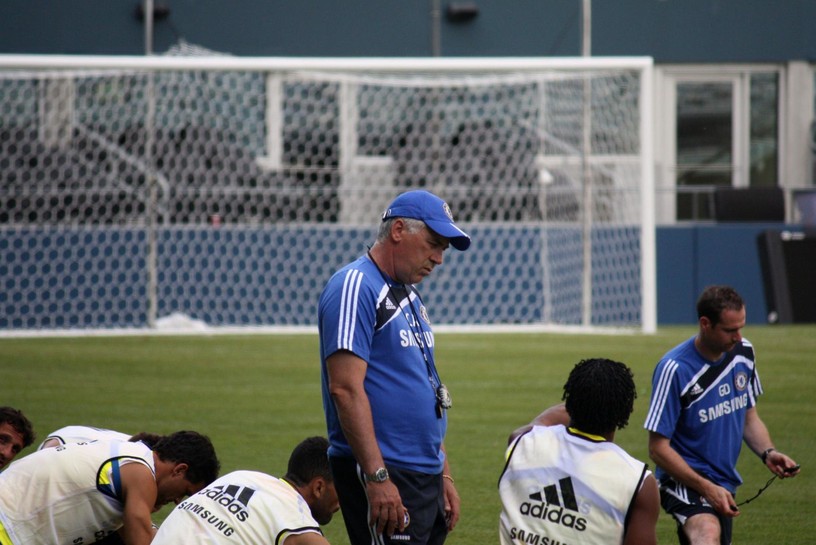
He may only have managed Chelsea for two seasons, but it’s difficult to underplay just how good Carlo Ancelotti was as Blues boss.
His became the first Chelsea side in history to do the Premier League and FA Cup double in 2009/10, and even in the following season they were in the hunt to defend their EPL title with just three games to go.
Ancelotti’s Chelsea smashed Premier League records – most goals scored in a single campaign, best goal difference more besides – and only failed to score in two of 53 games played in all competitions in 2009/10, which (you won’t be surprised to learn) is also a club record.
All told, Ancelotti’s win rate as Chelsea boss was 61%… at the time of his dismissal, that was the third best in Premier League history.
But, as things tend to do for Chelsea managers, it all went a bit sour in the first five months of 2011 – as Ancelotti has revealed in his new book, The Dream.
According to the Italian, he was sacked by Roman Abramovich for substituting Fernando Torres in a Champions League defeat to Manchester United.
Ancelotti’s book offers up a series of other incredible revelations about his time at Stamford Bridge, which saw ‘Don Carlo’ enter the Chelsea hall of fame in less than two years in the hotseat.
The Good Times
By the time he joined Chelsea in the summer of 2009, Ancelotti was already enjoying a burgeoning reputation as a successful head coach.
He’d won two Champions League titles, Serie A, Coppa Italia and the Club World Cup, amongst other things, as manager of AC Milan, but his switch to Chelsea would represent his first job outside of his native Italy.
So there was risk attached, although Ancelotti carried himself with the confidence of a man who felt as though success was an inevitability.
Squad Stars Deliver
He signed just three players in his first transfer window as Chelsea boss: Daniel Sturridge, Nemanja Matic and Yuri Zhirkov. But none of that trio would really be able to wrestle their way into their new manager’s preferred starting eleven.
Instead, Ancelotti lent on the services of his key lieutenants in Petr Cech, John Terry and Michael Ballack, managed to cajole Nicolas Anelka into some big performances and helped Frank Lampard and Didier Drogba deliver career-best seasons; they netted 22 and 29 Premier League goals respectively.
Chelsea won each of their first six Premier League outings, scoring 15 goals, with a 3-0 demolition of Tottenham the undoubted highlight.
Wigan ended the Blues’ 100% record, but another strong run thereafter – which saw 3-0, 4-0, 4-0 and 5-0 victories, with both Manchester United and Arsenal defeated in that spell – saw Ancelotti’s men establish themselves as the Premier League leaders.
Although knocked out of the League Cup early, Chelsea were also making good progress in the Champions League. They topped a group that had the potential to be a banana skin, with Atletico Madrid and Porto amongst the opposition, to book their spot in the knockout phase after Christmas.
December saw Ancelotti’s first sticky patch as Chelsea boss. His side won just two of their six Premier League outings in the month, but the new year brings with it a chance for a new start – and boy, did the Blues take it.
Their first EPL date in January saw Sunderland blasted aside 7-2, with six different Chelsea players on the scoresheet, with the month ending with the Blues enjoying a 100% record in the Premier League and winning through two rounds of the FA Cup.
Chelsea sat astride the Premier League table from mid-October until mid-March, at which point another wobble threatened to derail their season.
The Title Run-In
They were despatched by Inter Milan in the Champions League – a result that hurt Ancelotti personally, given his affinity for AC Milan, while defeats against Everton and Manchester City domestically, plus a draw at Blackburn, saw Chelsea drop off the top of the Premier League table for the first time in six months.
Would the wheels come off? Far from it. In fact, the Blues got stronger, producing an outrageous run of form until the end of the campaign.
They won Premier League games by scorelines of 4-1, 5-0, 7-0, 7-1 and 8-0 in what is one of the most dominant periods of form in the competition’s history. That latter triumph, secured against Wigan on the final day of the season, was – at the time – their record victory in the EPL.
Just six days after lifting the Premier League trophy, Chelsea contested the FA Cup final at Wembley. And, given the momentum they carried from the end of the league campaign, it was no great surprise when Portsmouth were beaten – Drogba capping his extraordinary season with the winning goal.
The Beginning of the End
Despite that early departure from the Champions League, Ancelotti’s first season as Chelsea boss was an unrivalled success – the Blues winning their first ever Premier League and FA Cup double.
The Italian tweaked his squad in the summer, with the likes of Ballack, Joe Cole, Ricardo Carvalho and Deco shown the exit door. In their stead came a low-key collection of signings, including Yossi Benayoun and Ramires… who would, of course, go on to become something of a Chelsea icon.
And it was déjà vu all over again, as the Blues won their first five games of the Premier League campaign – netting no less than 21 goals. They remained top of the table until November, at which point things started to go wrong for the Ancelotti regime.
Between November 7 and January 6, Chelsea won just two of their eleven Premier League outings. It was hard to put a finger on why, although revelations that subsequently came out suggest that Abramovich was becoming an increasingly troublesome presence – Ancelotti describing him as a ‘dark shadow’.
It was the Russian that demanded the January transfer window signings of Fernando Torres and David Luiz, before he sacked Ancelotti’s assistant – club icon Ray Wilkins – without first consulting the Italian.
Ancelotti struggled to integrate Torres into his plans – the Spaniard struggling with shattered confidence, but Abramovic insisted that his new striker play as many minutes as possible.
But things weren’t right, and a damned week in February – Liverpool losing to Liverpool and drawing 0-0 at Fulham – costing them further ground in the Premier League title race.
However, it was a defeat in the Champions League to Manchester United that effectively ended Ancelotti’s Chelsea tenure.
The Blues lost the first leg at the Bridge 0-1, which prompted Abramovich to call a meeting.
“The night before the second leg, Abramovich warned the squad that if they didn’t win there would be changes,” Ancelotti recalls in his book.
“He then told me that if we lost, I should not bother coming back in the next day.”
A 1-2 defeat at Old Trafford, with Torres substituted off at half-time, ultimately brought the curtain down.
Ciao, Carlo
That Champions League defeat sparked a revival in Chelsea’s Premier League form.
So much so, with three games left to go, they were just three points behind Manchester United – with another trip to Old Trafford on the horizon.
Once again, the Blues would come unstuck against the Red Devils, with Javier Hernandez’s goal inside the first minute setting the tone for a 1-2 defeat.
Ancelotti remained in place until the end of the season, at which point he was sacked less than 24 hours after the 0-1 defeat at Everton on the final day of the campaign.
Far from bitter, the Italian remembers his time at Stamford Bridge fondly.
“I remember every day that I was at Chelsea as a good day,” he writes.
A fitting epitaph to a remarkable two-year spell.